
I was invited to take part in a research study for the Imperial College London in February 2026 which was entitled ‘Motor unit behaviour in human movement disorders and spinal cord injury’
The objective of the study was to determine whether any voluntary movement disorders were present, as I experience weakness in my right hand and arm resulting from a stroke.
From the perspective of researchers, the underlying causes of these disorders remain unclear, which poses significant challenges in developing effective treatments.
Movement disorders can result from spinal cord injury, manifesting as weakness, sensory loss, spasticity, or incoordination.
In order to gain a deeper understanding of these disorders, the research team examines motor units.
Motor units are groups of spinal cord cells that control muscles through signals from the brain.
Through ongoing research and the study of motor unit behaviour, they can gain a deeper understanding of the coordination between muscles and nerves in controlling movement.
I arrived at the Imperial Biodynamics Laboratory in London and went to up to the room with Dr Elisabeth Rounis
There were two other people from the research who were going to help me take part in the studies.
It was explained that I would have high-density electromyography to record the activity of the motor units. There would be electrodes which were either placed on the skin over the muscles or directly on the muscles to record signals on both sides of my body, so my hands and my arms up to elbow length.
It could take about an hour whilst they put on the electrodes and then linked it on to the computer, video and then were ready to audio record the clinical assessment.
I was then going to be asked to perform several movements/computer based tasks, e.g reaching out to pick something up, raising a cup to drink something from my mouth, saluting, different finger movements etc. and each one I performed a few times.
This was going to be done with my left hand/arm the one that has not been affected by the stroke.
As I glanced at the computer on the table to my left, I noticed that the electrodes displayed on the screen mirrored those attached to my left hand and arm.
My hand movements were tracked and the purpose was to see what muscles are used during the movements.
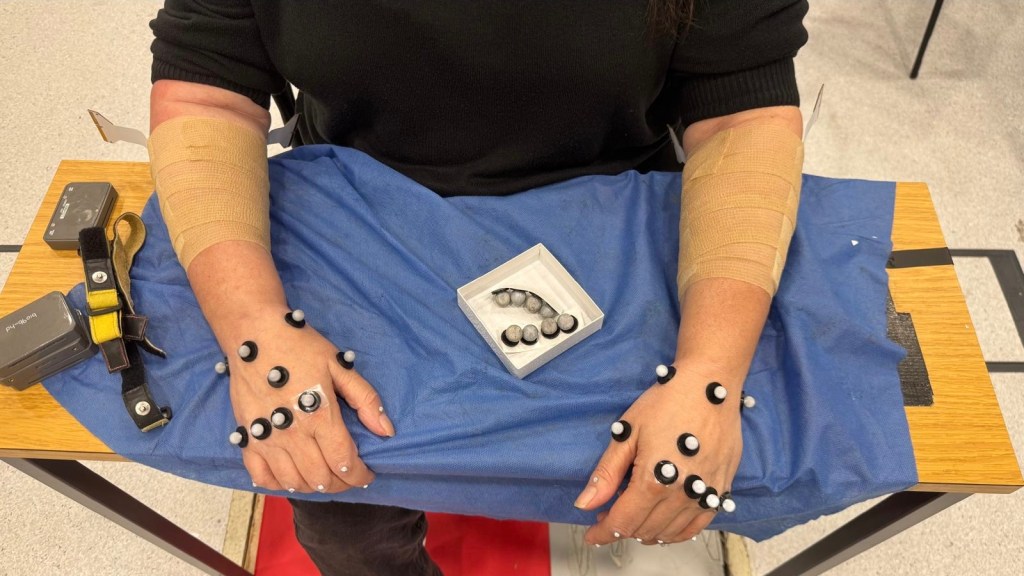
All tests finished successfully. We then studied a computer for movement on my right side.
The computer indicated minor muscular activity on my right side which was not visually detectable but nonetheless present.
I also lifted my right side to check for movement in my hand, arm, elbow, or shoulder as far as I possibly could.
I found the session valuable, and it will significantly contribute to expanding researchers’ knowledge and fostering the development of new tests and therapies using data on movement disorders.
In the lift going down the the main entrance, with Elisabeth, I commented that I will still to the gym as my right arm and hand are improving and it helps me stay focused on the goal especially from todays trial.
 Starting Again Life after 50