
(or Robotic Arm !)
This time, I was invited to take a 2 day trial – voluntarily, for The MOCAS Study or Robotic Arm by Dr Angelo.
A lot of people who have had a Stroke have suffered damage to the part of the brain that controls movement in the upper limb (arm and hand), so that you can no longer use it as you could before, which I definitely have.
I met Dr Angelo on the 5th November 2019 and he explained the study. He told me that there was no direct benefit for me taking part, in the sense that I should not expect my arm to change, but that the information that they will gain will improve our understanding of how people can continue to recover from their stroke in later months and years and may guide future development of treatment and services for all stroke survivors.
They were different criteria for who gets invited and I fell into the one that said :-
25 participants (like me) who suffered a stroke at least 3 months ago and are no longer under the care of a stroke team, but who have lasting problems with movement in one arm or hand, and will NOT be attending the upper limb rehabilitation programme and have never had any intensive rehabilitation for the affected arm or hand
Recent clinical and scientific studies have shown us that an intensive upper limb rehabilitation programme may also help reduce chronic arm and hand weakness and disability for people whose stroke occurred at least 3 months earlier. It is important that they understand how this is happening so that they can improve upon their knowledge of how people recover from a stroke and provide the best possible treatment at all stages of the recovery process to ensure the best possible outcomes for all stroke survivors.
Dr Angelo advised me what to expect, that the first session would last approximately 60 mins and the 2nd one (3 weeks later) about 45 mins
At each session, they will take some simple clinical measurements of the size, strength and range of motion of your arms. Then they would ask me to perform some simple reaching movements and behavioural tasks that allow them to make accurate measurements and assessments of various motor control processes occurring in the motor pathways between my brain and my upper limb.
Finally, Dr Angelo tasked me to complete a very short questionnaire about my levels of attention and concentration, fatigue, and the severity of any pain or stiffness that I may have. This is because these factors may also affect your motor control processes.
Robotic arm reaching task
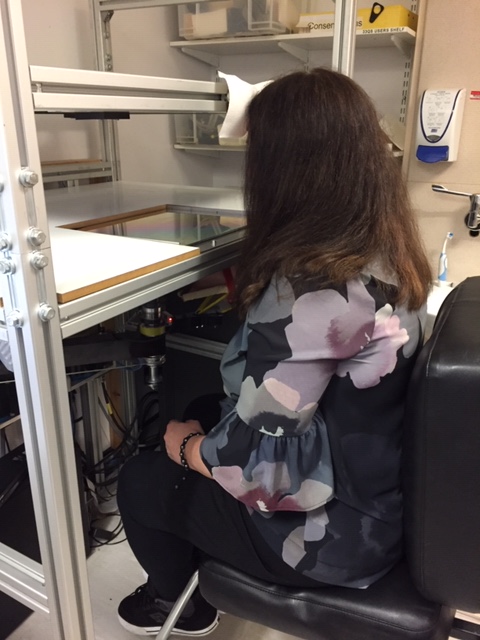
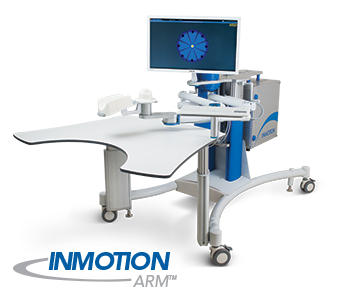
I sat in a high-backed chair with my forehead resting on a headrest in front of a workstation housing a robot controlled arm (pictured). I then had to place my left hand on the ‘Robotic Arm’. Moving the handle of the robotic arm controls a cursor displayed on a horizontal computer screen, positioned so that you cannot see what your arm is doing. It allows you also to take the weight from the arm and actually it allows you to feel normal again (until the straps are taken of and the arm goes back down to the side !!!!) but hey ho !
He then asked me to make repeated simple reaching movements to move the cursor between selected targets and at different speeds.
The robot makes precise measurements of your reaching movements, such as the position of the arm, the speed of the movement, or the force with which you move the arm. They will analyse this data once I have finished testing to learn about the motor control of my arm. Also they will test my ability to adapt to changing conditions by asking the robot to interfere with the movements that I make towards the targets.
So, Dr Angelo placed my left hand first in the robotic arm (which I have to say was fine – phew)
Then he put my right arm in the robotic arm……So, in my head, there was a 360 degree invisible target, with my right hand in the centre of it.
I could reach (in a wobbly kind of way ) the targets for the left side. I did the targets on the right hand side, but (probably between 2 o’clock and 5 o’clock), I went to the targets but not inside the targets before the robot dragged me back. Sometimes it did it but sometimes not. Dr Angelo said it was that I could not extend my muscle.
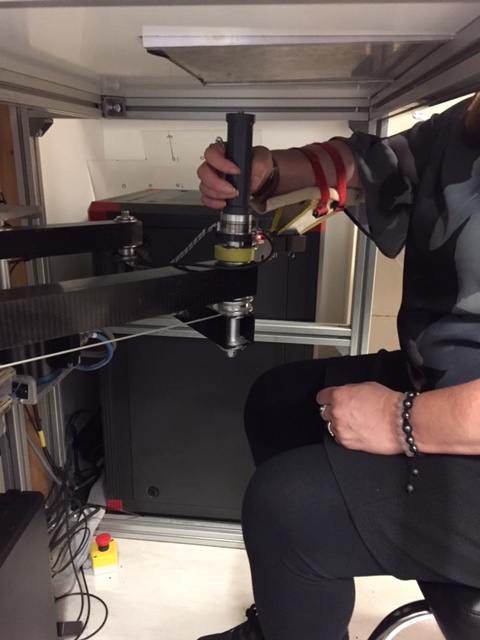
We recorded the trial and then I came back on the 22nd November to do it again.
It was weird because the targets (between 2 o’clock and 5 o’clock) this time on the second attempt were better……
So, the two days of the trials for me was exciting (I know now what a type of Robotic Arm looks like) intriguing to see how they do the trials but most importantly, the research that goes with it for each of the criteria .
Testing motor control behaviour with the robot- controlled arm is a well established , non invasive method which will not cause anybody any harm and, once the study is complete, there will a summary report of the main findings.
 Starting Again Life after 50